Comparison
Grais vs ChatGPT (2026)
Grais vs ChatGPT, checked August 2026. ChatGPT is a destination you open for anything. Grais drafts the reply inside the thread you already have open, with memory per relationship.
- Facts checked
- August 18, 2026
- Rows compared
- 11
- Sources cited
- 14
The short answer
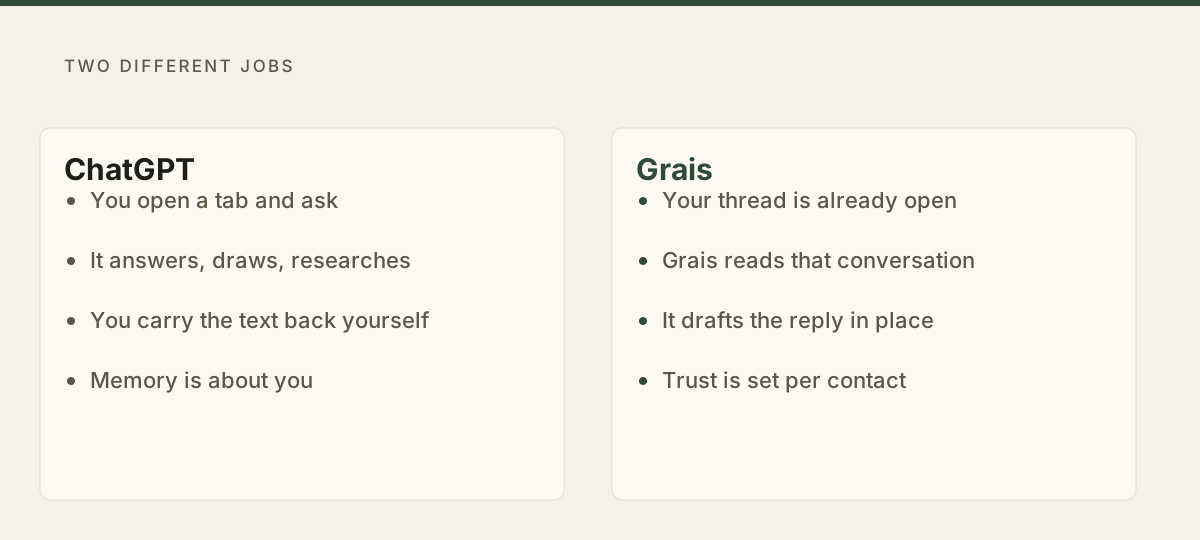
ChatGPT answers questions, makes images, runs research and analyses files, in its own tab or app. Pick it for breadth, and for a free plan with unlimited text chats. Pick Grais when the work is the reply itself: the thread you already have open, memory per relationship, and a send-trust level per contact.
- Pick ChatGPT when
- Pick ChatGPT for one assistant covering questions, images, voice, research, analysis and code, with a free tier and apps on every device.
- Pick Grais when
- Pick Grais when the work is the reply itself: live threads with specific people, where history, tone and what you promised decide the outcome.
Side by side
ChatGPT vs Grais, row by row
Rows won
- ChatGPT
- 5
- Even or not scored
- 1
- Grais
- 5
| Comparing | ChatGPT | Grais |
|---|---|---|
| Native assistant contact in the chat | Partial Rakuten Viber carries @ChatGPT mentions and draft polishing, and WhatsApp works again across the EEA. Edge: ChatGPT | No Grais is not a contact you @-mention; the extension drafts your reply in the open thread instead. |
| Free tier | Yes The Free plan is $0 a month and includes unlimited text chats. Edge: ChatGPT | Partial Grais is invitation only. New accounts require approval; existing accounts keep their access. New purchases are paused. |
| Mobile app you can install today | Yes Public iOS and Android apps ship on every tier, including Free. Edge: ChatGPT | Partial Grais on iOS is TestFlight and waitlist only, with no Android build. |
| Breadth in one subscription | Yes Images, voice, deep research, data analysis, custom GPTs and connectors are included. Edge: ChatGPT | Not a focus Grais does one job, communication, and attempts none of that work. |
| Browsers and devices it runs on | Yes Any browser including Safari and Firefox, plus macOS and Windows desktop apps. Edge: ChatGPT | Partial Chromium desktop only: Chrome, Brave, Edge and Arc, with no mobile browser. |
| Works inside your open WhatsApp, LinkedIn or Telegram thread | No No documented ChatGPT surface reads a signed-in messaging thread and drafts inside it. | Yes The Chromium extension drafts inside WhatsApp Web, Telegram Web, Instagram, LinkedIn and Tinder. Edge: Grais |
| Memory keyed to a specific person | Partial Memory is a synthesis of your own chats, files and connected apps. | Yes Memory is organised per relationship: who said what, and what matters to them. Edge: Grais |
| Remembers what you promised a named contact | No OpenAI documents no commitment tracking tied to an individual counterparty. | Yes Promise tracking keeps what you committed, and to whom, after the thread scrolls away. Edge: Grais |
| Same person recognised across channels | No ChatGPT has no identity model spanning your separate messaging accounts. | Yes One human stays one relationship across WhatsApp, LinkedIn and Telegram at once. Edge: Grais |
| Send permission that changes per contact | No ChatGPT hands you text, and what happens next is entirely yours. | Yes Trust rises per contact from review, to voice approval, to known-safe autonomy. Edge: Grais |
| Best for | Yes Anyone wanting one assistant for questions, images, research, analysis and code. | Yes Anyone whose real workload is replies to specific people in live threads. |
Where they win
Where ChatGPT is the stronger pick
Grais is invitation only. New accounts require approval; existing accounts keep their access. New purchases are paused.
It also runs almost everywhere: the web in any browser, including Safari and Firefox, public iOS and Android apps, and desktop apps for macOS and Windows. You can also phone it, on 1-800-CHATGPT or +1-800-242-8478, from United States and Canadian numbers with thirty free minutes a month. Grais is a Chromium desktop extension with iOS on TestFlight and no Android product. On a phone, ChatGPT wins outright today.
The capability list is not close either. One subscription covers image generation, voice, deep research, data analysis, vision, custom GPTs, Projects and scheduled tasks. Grais does none of that work. ChatGPT also ships first-party connectors into internal tools; Grais reaches those tools through MCP and Skills. For teams, ChatGPT Business is $25 per user per month, with an admin console, SSO and SOC 2 Type 2, and Enterprise adds SCIM and IP allowlisting. Grais publishes two individual plans and no admin or compliance tier.
ChatGPT also has more messaging presence than a quick look suggests. Inside Rakuten Viber it works in the thread: @ChatGPT mentions, AI Polish on a draft before it sends, and summaries of unread group messages, all built by Viber. On WhatsApp the story runs in two acts. ChatGPT left WhatsApp after 15 January 2026 following a Meta policy and terms change, and the OpenAI help centre, updated around 31 July 2026, states it is available again on WhatsApp in the European Economic Area at +1-800-242-8478, with no account needed. On Apple devices, Writing Tools can also compose with ChatGPT into any text field.
The difference
What Grais does differently
Grais does one job: the reply. It runs as a browser extension on the conversation already open in front of you, across WhatsApp Web, Telegram Web, Instagram, LinkedIn and Tinder. Nothing gets pasted anywhere. It reads what is on screen, drafts the answer in your voice, and leaves it for review.
The difference is architectural rather than a quality gap, and OpenAI documents its own boundary clearly. Work with Apps on macOS covers text editors, code editors and terminals, with no messaging app on the list. The cloud browser works on public pages only and stops at any sign-in. The built-in desktop browser uses its own state, not your Chrome profile. The one surface that does reach your existing Chrome session is the Codex extension, which OpenAI frames as browser-agentic developer work reached from a chat in Work or Codex. OpenAI does not document it as a messaging composer, and no OpenAI article describes it drafting inside a WhatsApp Web, LinkedIn or Telegram Web thread.
Memory points at the other person. ChatGPT keeps a continually updated synthesis of your chats, files and connected apps to personalise your answers. Grais keeps memory per relationship instead: who said what, what was promised, what matters to that contact. The same person stays one relationship whether they wrote on WhatsApp, LinkedIn or Telegram.
Permission is granted per contact. Trust starts at review, moves to voice approval, and can reach known-safe autonomy, one relationship at a time, and nothing sends without the level set for that contact. The reasoning layer watches the relationship rather than the prompt box: it tracks promises and flags when someone has gone quiet.
Grais is invitation only. New accounts require approval; existing accounts keep their access. New purchases are paused.
Also worth knowing
Where Claude fits in this comparison
Claude, from Anthropic, does the same job as ChatGPT: a destination assistant you open for writing, research, analysis and code. Its plans are Free at $0, Pro at $17 a month on annual billing or $20 monthly, Max from $100, and Team standard seats at $20 to $25.
One Claude fact matters more than the rest here. Claude in Chrome is a first-party extension on all paid plans, and from a side panel it reads page text, clicks buttons and fills forms. That is the closest either large lab has to the surface Grais occupies, and calling the browser empty territory would be wrong.
What it is not is a messaging assistant. Claude in Chrome is a general browser agent, driven by what you ask it to do on the page in front of it. It has no per-contact memory, no record of what you promised a named person, and no send-trust level for one recipient. The side panel is not the moat. The per-contact memory, promise tracking and per-contact send permission are.
What each costs
Pricing
Prices move. Each column prints the date those numbers were read, and links to a public page from the company itself. Where a company publishes no pricing page, the notes under its plans say where the numbers came from.
ChatGPT
As of August 18, 2026
- Free$0
- Unlimited text chats, with limited image generation, voice, memory and deep research.
- Go$8 / month
- More messages, uploads and image creation than Free, and longer memory.
- Plus$20 / month
- Advanced reasoning, expanded deep research, Projects, scheduled tasks and custom GPTs.
- ProFrom $100 / month
- $100 buys five times Plus usage; $200 buys twenty times, with maximum memory.
- Business$25 / user / month
- Admin console, SSO and SOC 2 Type 2, from two users, or $20 billed annually.
- EnterpriseCustom
- Adds SCIM, IP allowlisting, compliance logs and a global admin console.
- These are the United States prices; OpenAI localises by region rather than converting them.
- There is no annual billing for Go, Plus or Pro. Only Business and Enterprise are sold annually.
- OpenAI states on the pricing page that the Go plan may include ads.
Grais
As of August 18, 2026
- Invitation onlyBy invitation
- New accounts require approval. Existing accounts keep their current access.
FAQ
Questions people actually ask
Can ChatGPT reply to my WhatsApp messages for me?
Not inside your own chats. ChatGPT left WhatsApp after 15 January 2026 following a Meta terms change, and the OpenAI help centre, updated around 31 July 2026, states it is available again on WhatsApp in the European Economic Area at +1-800-242-8478. Even there it answers in its own thread rather than reading your conversation with a friend.
How much does ChatGPT cost, and is there a free plan?
There is. Free is $0 a month. The United States paid prices are Go at $8, which may include ads, Plus at $20, and Pro at $100 for five times Plus usage or $200 for twenty times. Business is $25 per user monthly, $20 annually. There is no annual billing on Go, Plus or Pro.
Does ChatGPT remember the people I talk to?
It remembers you rather than your contacts. Memory is a continually updated synthesis of your own chats, files and connected apps, and OpenAI states the visible summary will not include everything it remembers. There is no per-contact memory, no record of a promise made to a named person, and no identity following someone across messaging apps.
Can ChatGPT read the page I am on and write in it?
Partly, and not on messaging apps. Work with Apps on macOS covers text editors, code editors and terminals, with no messaging app listed. The cloud browser handles public pages and stops at any sign-in, and the built-in desktop browser uses its own session, not your Chrome profile. The Codex extension does reach your existing signed-in Chrome tabs, but OpenAI documents it as developer and browser-agent work, not as a messaging composer.
Is Claude a closer match to Grais than ChatGPT?
On surface, yes. Claude in Chrome is a first-party extension on all paid plans that reads pages, clicks and fills forms from a side panel, nearer to where Grais sits than anything OpenAI documents. It is still a general browser agent, without per-contact memory, promise tracking or a send-trust level for one recipient.
Sources
- ChatGPT pricing page
- OpenAI help centre: 1-800-ChatGPT calling and messaging
- OpenAI: continuing your ChatGPT experience beyond WhatsApp
- OpenAI help centre: using ChatGPT in Viber
- OpenAI help centre: memory FAQ
- OpenAI help centre: Work with Apps on macOS
- OpenAI help centre: using cloud browser in ChatGPT
- About ChatGPT Pro tiers, OpenAI help centre
- Using the built-in browser in the ChatGPT desktop app
- Apple Intelligence and ChatGPT, OpenAI help centre
- Claude pricing page
- Anthropic support: get started with Claude in Chrome
- Grais pricing page
- Grais product page
Facts checked August 18, 2026. ChatGPT's features and pricing come from the public sources cited on this page. ChatGPT is a trademark of its owner and is named here only to identify the product being compared.