Comparison
Grais vs Superhuman Go (2026)
Grais vs Superhuman Go, checked September 2026. Go puts agents in every tab with live work-app context. Grais drafts for one person, with memory and per-contact send trust.
- Facts checked
- September 9, 2026
- Rows compared
- 11
- Sources cited
- 10
The short answer
Superhuman Go, from Superhuman Platform Inc., formerly Grammarly Inc., puts writing agents and work-app context in every tab you type in. Grais drafts for one specific person, carrying relationship memory, promise tracking and per-contact send trust. Pick Go for professional output everywhere. Pick Grais when the conversation, not the document, is the work.
- Pick Superhuman Go when
- Pick Superhuman Go when you want proofreading, drafting and live work-app context in every application and tab you already use, on a free plan or at $12 per member per month.
- Pick Grais when
- Pick Grais when one relationship runs for months across several messaging apps, and you want the assistant to remember what was promised and to send only at the trust level you set for that person.
Side by side
Superhuman Go vs Grais, row by row
Rows won
- Superhuman Go
- 5
- Even or not scored
- 1
- Grais
- 5
| Comparing | Superhuman Go | Grais |
|---|---|---|
| Best for | Yes Professionals who want proactive AI polish and work-system context inside every tab and application they already use. | Yes People running high-stakes personal conversations who need the relationship remembered and per-contact control over what sends. |
| Free tier and entry price | Yes A $0 Free plan includes limited Go chat access, and Pro is $12 per member per month billed annually. Edge: Superhuman Go | Partial Grais is invitation only. New accounts require approval; existing accounts keep their access. New purchases are paused. |
| Where it runs | Yes Superhuman says Go works across more than a million websites and apps by attaching to the text fields on screen. Edge: Superhuman Go | Partial Grais supports five named web apps: WhatsApp Web, Telegram Web, Instagram, LinkedIn and Tinder. |
| Grammar and writing correction | Yes Real-time grammar, punctuation and word-choice review is the core job, with mistake-free writing in 20+ languages on the free plan. Edge: Superhuman Go | Not a focus Grais calibrates tone to your voice and the relationship, but it is not a proofreader. |
| Connectors to work systems | Yes Connectors pull live context from work tools including Salesforce, HubSpot, Jira, GitHub, Confluence and Zoom. Edge: Superhuman Go | Partial Grais reaches work tools through MCP and Skills rather than first-party connectors of the kind Superhuman lists. |
| Native desktop and mobile | Yes Superhuman ships Go as a Mac app, a Windows app and an iOS app, with Android listed as coming soon. Edge: Superhuman Go | Partial Grais is a Chromium desktop extension today, with iOS on TestFlight and a Mac app planned. |
| Personal messaging channels | Not a focus Superhuman does not name WhatsApp Web among its supported surfaces, though Instagram and LinkedIn both appear in its supported-apps list. | Yes WhatsApp Web, Telegram Web, Instagram, LinkedIn and Tinder are the surfaces Grais is built around. Edge: Grais |
| Memory of one person over time | No The Superhuman agents page states that by default agents do not retain information between sessions or across different agents. | Yes Grais keeps context across conversations, channels and time, including who said what and what matters per relationship. Edge: Grais |
| The same person across apps | No Go draws on the active window and connected work systems, with no documented link between two messaging apps. | Yes Grais carries one relationship history for the same person across WhatsApp, LinkedIn and Telegram. Edge: Grais |
| Promise and commitment tracking | No Superhuman publishes no feature that tracks what you committed to a particular person over time. | Yes Grais remembers what was promised to whom, and flags when a person goes quiet. Edge: Grais |
| Control before anything is sent | Partial Control is a per-tool Always Allow or Needs approval toggle in connector settings, often set by an admin. | Yes Trust is set per contact and grows from review, to voice approval, to known-safe autonomy. Edge: Grais |
Where they win
Where Superhuman Go is the stronger tool
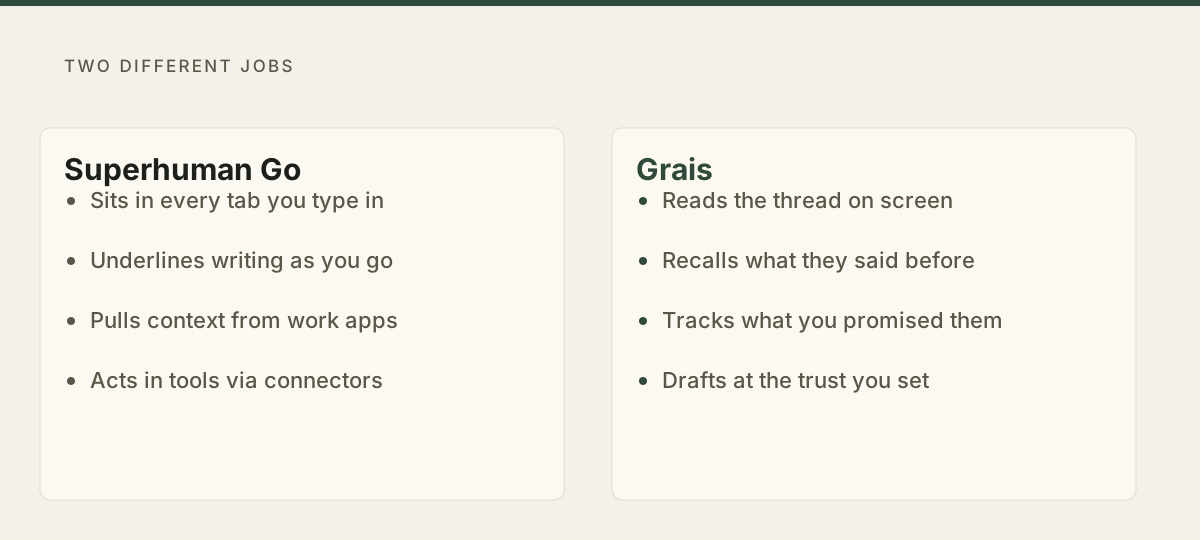
Superhuman Go is made by Superhuman Platform Inc., the company that was Grammarly Inc. until it rebranded on 29 October 2025. Grammarly is now one agent inside a suite that also holds Superhuman Docs, Superhuman Mail and Go. Go itself is the overlay: a browser extension, a desktop app and a mobile app that puts agents on top of whatever you already have open.
Reach is the real headline. Superhuman says Go works across more than a million websites and apps, because the model is text fields rather than a curated list of sites. It ships as a Chrome and Edge extension, as Mac and Windows apps, on iOS, and as a web app, with Android listed as coming soon. The Grammarly browser page counts 40 million people and 50,000 organizations.
Grais is invitation only. New accounts require approval; existing accounts keep their access. New purchases are paused.
The writing help is also the thing this company has been doing longest. That means real-time grammar, punctuation and word-choice review, with full-sentence rewrites and tone adjustment on Pro and above, and mistake-free writing in 20+ languages on the free plan. Grais does not do that work and does not claim to.
- The work is documents and email. Go is aimed at professional written output, and it sits inside Google Docs, Gmail and Outlook.
- The context lives in work systems. Connectors pull live data from Salesforce, HubSpot, Jira, GitHub, Confluence and Zoom while you write.
- You need admin and security controls. Enterprise adds SAML SSO, SCIM, data loss prevention, audit logs and BYOK encryption. Grais publishes none of that.
The difference
What Grais does instead
Grais is not an overlay on everything you type. It reads the one conversation you have open, whether that is a WhatsApp Web thread, a LinkedIn message or a Telegram chat, and drafts the next message to that specific person in your voice. The unit of work is a relationship, not a document.
That changes what the assistant has to know. Superhuman states on its own agents page that by default agents do not retain information between sessions or across different agents. What stands in for memory is retrieval: connectors pull live context from Gmail, Jira or Salesforce at the moment you type. Grais holds the other half, which is recall. It keeps context across conversations, channels and time, covering who said what, what was promised and what matters to this person, so a thread you left three weeks ago on a different app is still in the room.
Two things follow from that. Promise tracking means the assistant knows what you committed to whom, rather than re-reading the last screen. And because the memory is per person rather than per window, the same human on WhatsApp, LinkedIn and Telegram is one relationship with one history, which is also what lets Grais flag when that person has gone quiet.
The control model differs in the same direction. The control Superhuman describes for connectors is a per-tool Always Allow or Needs approval toggle in connector settings, often set by an admin rather than per conversation. Grais sets trust per contact. It starts at review, can move to voice approval, and can reach known-safe autonomy for the people where that has been earned. Nothing is sent or changed without the trust level you set for that contact.
The honest part. Grais is a desktop Chromium extension, covering Chrome, Brave, Edge and Arc on macOS, Windows, Linux and ChromeOS. There is no mobile browser, no Firefox and no Safari. iOS is on TestFlight rather than the App Store, and the Mac app is planned rather than shipped. If breadth of surfaces is what decides it, Go wins that outright.
Also worth knowing
Running both at once
These two are not competing for the same minute of the day. The centre of gravity for Go is the document, the email and the ticket, with context retrieved from systems of record. For Grais it is the thread with one person, with context that accumulates in the relationship.
Superhuman documents a per-site switch for anyone running both: the Go extension can be turned off for a particular website. Grais only activates on the five sites it supports, so the overlap is small to begin with.
What each costs
Pricing
Prices move. Each column prints the date those numbers were read, and links to a public page from the company itself. Where a company publishes no pricing page, the notes under its plans say where the numbers came from.
Superhuman Go
As of September 9, 2026
- Free$0
- Includes limited Go chat access in every application and tab.
- Pro$12 per member per month, billed annually
- Also sold at $15 per month billed monthly. This is the lowest tier that can connect work apps and build custom agents.
- Business$33 per member per month, billed annually
- Also sold at $40 per month billed monthly, and adds Superhuman Mail, the email client in the same suite.
- EnterpriseCustom
- Adds SAML SSO, SCIM, data loss prevention, audit logs and BYOK encryption, priced on request.
- These are the USD figures Superhuman publishes. The plans page renders local currency by region.
- Go chat sits on the free plan. Connectors and custom agents require Pro, Business or Enterprise.
- Superhuman Mail is a separate product in the same suite and arrives with the Business plan.
Grais
As of August 18, 2026
- Invitation onlyBy invitation
- New accounts require approval. Existing accounts keep their current access.
FAQ
Questions people actually ask
Is Superhuman the same company as Grammarly?
Yes. Superhuman Platform Inc. was Grammarly Inc. until the rebrand announced on 29 October 2025, after the company acquired Coda in December 2024 and the Superhuman email client in July 2025. Grammarly is now one product inside the Superhuman suite, alongside Superhuman Docs, Superhuman Mail and Superhuman Go.
What is the difference between Superhuman Go and Superhuman Mail?
They are separate products from the same company. Superhuman Mail is an email client, and it arrives on the Business plan at $33 per member per month billed annually. Superhuman Go is the assistant that overlays agents on the sites and apps you already use, as a browser extension, desktop app and mobile app. Go chat is on the free plan, while connectors and custom agents require Pro or above.
Does Superhuman Go work in WhatsApp Web?
Superhuman does not name WhatsApp Web among its supported surfaces. Its supported-apps list names Gmail, Google Docs, Outlook, Jira, Salesforce, X, LinkedIn, Instagram and Facebook, but not WhatsApp Web or Telegram Web. Go attaches to text fields, and its documentation notes that it does not start in text areas under 38 pixels tall. Grais supports WhatsApp Web, Telegram Web, Instagram, LinkedIn and Tinder.
Will Superhuman Go remember what I promised someone?
Superhuman states on its own agents page that by default agents do not retain information between sessions or across different agents. Context comes from the active window plus whatever the connectors retrieve live from your work tools at that moment. Grais is built the other way around, keeping a per-person history across conversations, channels and time, including what was promised and when someone went quiet.
Is Superhuman Go cheaper than Grais?
Grais is invitation only. New accounts require approval; existing accounts keep their access. New purchases are paused.
Sources
- Superhuman Go product page
- Superhuman agents page, including the default memory statement
- Superhuman plans
- Introducing the Superhuman suite, with USD plan prices
- Superhuman Go browser extension user guide
- About Superhuman Go agents and connectors
- Superhuman Go 1.0 launch post, including paid-plan gating
- Grammarly browser extension page, supported apps and scale claims
- Company rebrand to Superhuman
- Grais pricing
Facts checked September 9, 2026. Superhuman Go's features and pricing come from the public sources cited on this page. Superhuman Go is a trademark of its owner and is named here only to identify the product being compared.